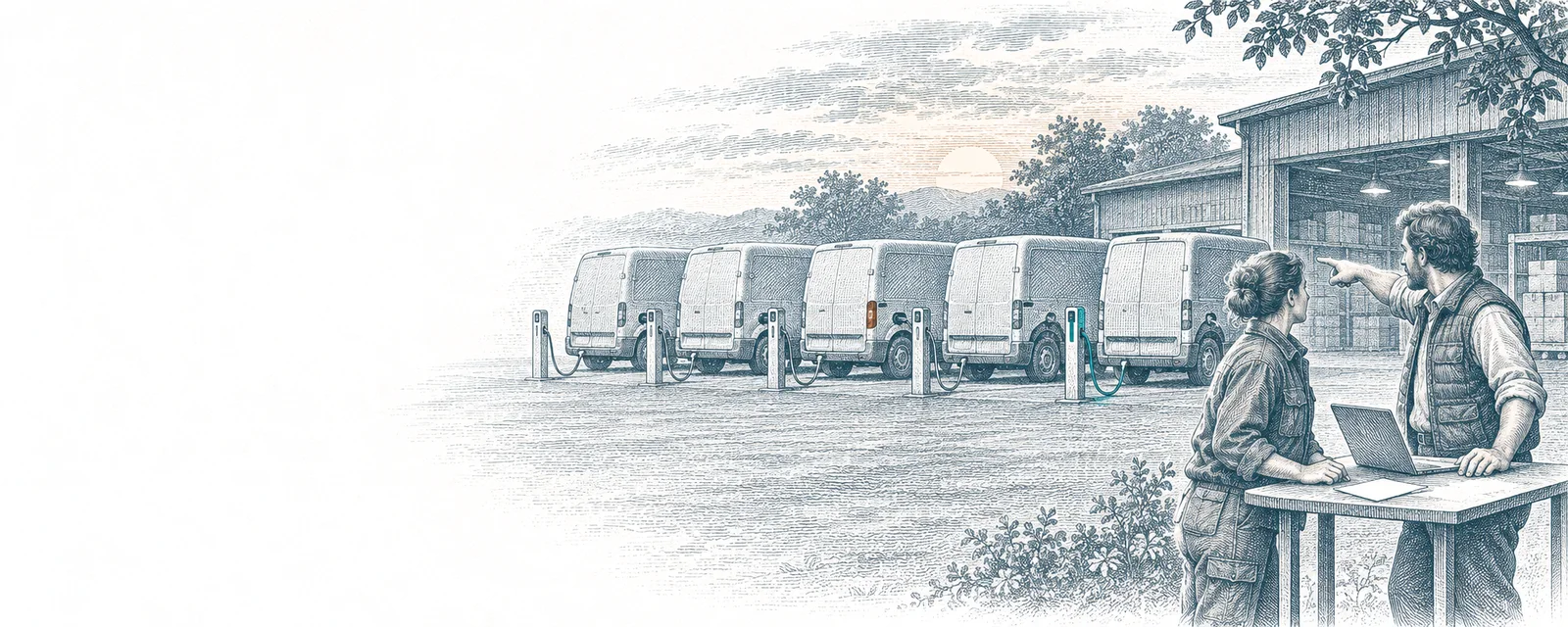
Engraving: five electric delivery vans charging in a depot yard, two people with a laptop in front of them.
Simulation

One year, five decisions: the Ladefluss simulation

A transport company wants to expand its fleet from 40 to 70 electric delivery vans. Then the market collapses, and two opportunities demand an answer within days. Each round puts three options on the table: first an own choice, then the scoring of all three side by side.

The company, data, news items, decisions and results are invented.

Bank
€500,000
Fleet
40
Utilisation
82%
Result per month
+€13,000

The starting position

Ladefluss runs 40 electric delivery vans that carry parts between suppliers and car plants in the Stuttgart area. The last few years went well: the fleet is busy, and after all costs €13,000 a month is left.

40
Vehicles
82%
Utilisation
€13,000
Profit per month
€500,000
Bank balance

Now an expansion is on the agenda. A large supplier wants to switch its plant traffic to electric vehicles and holds out the prospect of routes for up to 30 more vans. The plan for the year: from 40 to 70 vehicles, in three steps of ten.

Three rules for the year
  1. Utilisation At 65% utilisation a vehicle earns nothing. Every percentage point above brings €100 a month.
  2. Standstill A vehicle without routes costs €1,500 a month.
  3. Two goals Earnings has the weight 7, reserve the weight 9. The reserve weighs more because a company without a reserve can no longer correct any decision.
The plan in figures
The January plan
Vehicles40 today, 70 in December. Vehicles are bought in three steps of ten: in January, April and July.
Purchase price€60,000 per vehicle, €600,000 per step, €1.8 million in total
Financingper step €120,000 from the bank balance and a €480,000 loan at 6%
Interest€2,400 a month per step
Expected utilisation of the new vehicles85%
Expected contribution€2,000 per vehicle per month, €240,000 per step per year. The contribution is the revenue of the routes minus driver, electricity, maintenance and depreciation.
Running costsAdministration, dispatch and depot: €55,000 a month, plus interest

Five decisions from January to September, and the final account in December. Each round has three options: first an own choice, then the scoring of all three side by side.

January Decision 1 of 5

Expanding the fleet

Situation

News
  • Trade newsletter Suppliers are switching their plant traffic to electric vehicles. Several carmakers will require emission-free deliveries from next year.
  • Business news The carmakers expect stable volumes for the year.

The supplier names routes for ten vehicles from February, and later for up to 30. What it has signed is a letter of intent, not a contract.

The van dealer offers a 5% discount if Ladefluss orders all 30 firmly.

Cockpit

Cockpit

82%

Fleet utilisation

  • Threshold 65%

84%

Routes for the next three months

  • Threshold 65%

€330

Profit per vehicle per month

  • Threshold 0

Bank balance

€500,000

Jan Dec

Interest per month: €0

Vehicles

40

  • 40 carries parts
  • 30 in the plan, not bought

What this means for the decision

  • Good The existing fleet pays its way: 82% utilisation, 17 points above the threshold of 65%.
  • Caution The 85% for new vehicles is an assumption. Only the existing fleet has been measured.
  • Good €500,000 in the bank covers the equity share of the whole plan, €360,000.

Decision

How firmly should Ladefluss commit to the expansion?

After the choice all three options are scored side by side. The choice is not stored.

Scoring

All options at a glance

Baseline (F0): No expansion: Ladefluss stays at 40 vehicles.

  1. Order all 30 firmly Full commitment −5.9 Own choice
  2. Order ten, then check again Half commitment +4.5 in front Own choice
  3. Reserve and wait for the contract Wait +1.8 Own choice
Full commitment · commits €1,710,000 Order all 30 firmly

in favour 20.8 against 26.7 Net score −5.9

  • Contribution from the new routes €720,000 a year V 7 · I 7.2 · P 3 15.1

    30 vehicles at 85% utilisation, €2,000 per vehicle per month

    The letter of intent names routes for ten vehicles. The other 20 are only held out as a prospect.

  • Volume discount €90,000 once V 7 · I 0.9 · P 9 5.7

    5% of €1.8 million

    The dealer's offer is on the table in writing.

  • Interest €86,400 a year V 9 · I 0.9 · P 9 7.3

    €1.44 million loan at 6%

    The bank's loan offer is on the table in writing.

  • New vehicles standing idle €540,000 a year V 9 · I 5.4 · P 4 19.4

    30 vehicles without routes, €1,500 per vehicle per month

    For 20 of the 30 vehicles there are no routes yet, and nothing can be cancelled.
Half commitment · commits €600,000 Order ten, then check again

in favour 10.1 against 5.6 Net score +4.5

  • Contribution from the new routes €240,000 a year V 7 · I 2.4 · P 6 10.1

    10 vehicles at 85% utilisation, €2,000 per vehicle per month

    The letter of intent names routes for these ten vehicles. It is not a contract, and the 85% is an assumption based on the existing fleet.

  • Interest €28,800 a year V 9 · I 0.3 · P 9 2.4

    €480,000 loan at 6%

    The bank's loan offer is on the table in writing.

  • New vehicles standing idle €180,000 a year V 9 · I 1.8 · P 2 3.2

    10 vehicles without routes, €1,500 per vehicle per month

    The carmakers expect stable volumes. A whole industry cutting its orders last happened in 2020.

Wait · commits €20,000 Reserve and wait for the contract

in favour 3.4 against 1.6 Net score +1.8

  • Contribution from the new routes €120,000 a year V 7 · I 1.2 · P 4 3.4

    at most half of the routes, from May

    The supplier starts in February with whichever firm has vehicles. A latecomer gets what is left, if anything.

  • Reservation fee €20,000 once V 9 · I 0.2 · P 9 1.6

    is not credited against an order

    The fee is stated in the dealer's offer.

V: how important. I: how large. P: how well supported. Tap a row for the calculation and the evidence.

The large order promises the most and has the weakest support: firm statements exist for ten vehicles only. Waiting costs a fee and the opening routes. The step that commits as far as the evidence reaches is in front.

Resolution

Own choice: Net score

Decision · January

Ten vehicles are ordered. The second step gets a condition.

Order ten, then check again · Net score +4.5 · in front

The ten vehicles run from February. The second step follows in April only if the contract is signed and the new vehicles reach at least 75% utilisation. The condition is fixed before the first data arrive.

Next review: early April with the measurements from February and March.

April Decision 2 of 5

The first data of its own

Situation

News
  • Business news Two carmakers lower their sales forecasts for the year by 5% each.
  • Trade newsletter Suppliers report more cautious orders for the second quarter.

The ten new vehicles have been running since February, at 80% in March. The plan was 85%. The supplier has signed: for the second stage from May the contract names fixed routes for five vehicles, and for five more only orders on demand.

Both January conditions are met.

Cockpit

Cockpit

82%

Fleet utilisation

  • Threshold 65%
  • Plan 83%

79%

Routes for the next three months

  • Condition 75%

€510

Profit per vehicle per month

  • Threshold 0
  • Plan €610

Bank balance

€434,000

Jan Dec

Interest per month: €2,400

Vehicles

50

  • 50 carries parts
  • 20 in the plan, not bought

What this means for the decision

  • Good The new vehicles reach 80%. The condition of 75% for the second step is met.
  • Caution Profit per vehicle is €100 below plan because 80% was reached instead of 85%.
  • Caution Committed routes fall from 84% to 79%. That is the first sign from outside.

Decision

How large should the second step be?

After the choice all three options are scored side by side. The choice is not stored.

Scoring

All options at a glance

Baseline (F0): No second step: Ladefluss stays at 50 vehicles and cancels the second stage.

  1. Buy ten as planned Full commitment −2.9 Own choice
  2. Buy five Half commitment +1.0 in front Own choice
  3. Postpone for three months Wait +0.4 Own choice
Full commitment · commits €600,000 Buy ten as planned

in favour 7.6 against 10.5 Net score −2.9

  • Contribution from the new routes €180,000 a year V 7 · I 1.8 · P 6 7.6

    10 vehicles at 80% utilisation, €1,500 per vehicle per month

    The 80% was measured on the company's own vehicles. But fixed routes exist for only five of the ten.

  • Interest €28,800 a year V 9 · I 0.3 · P 9 2.4

    €480,000 loan at 6%

    The bank's loan offer is on the table in writing.

  • New vehicles standing idle €180,000 a year V 9 · I 1.8 · P 5 From outside · P 2 → 5 8.1

    10 vehicles without routes, €1,500 per vehicle per month

    Two carmakers lower their forecasts, and committed routes fall from 84% to 79%. Orders on demand are the first to go.

Half commitment · commits €300,000 Buy five

in favour 5.0 against 4.0 Net score +1.0

  • Contribution from the new routes €90,000 a year V 7 · I 0.9 · P 8 Learned · P 6 → 8 5.0

    5 vehicles at 80% utilisation, €1,500 per vehicle per month

    The 80% was measured on the company's own vehicles, and the routes are fixed in the contract.

  • Interest €14,400 a year V 9 · I 0.1 · P 9 0.8

    €240,000 loan at 6%

    The bank's loan offer is on the table in writing.

  • New vehicles standing idle €90,000 a year V 9 · I 0.9 · P 4 From outside · P 2 → 4 3.2

    5 vehicles without routes, €1,500 per vehicle per month

    The carmakers' outlook is darkening. But fixed routes are the last thing a customer cuts.

Wait · commits €20,000 Postpone for three months

in favour 2.0 against 1.6 Net score +0.4

  • Contribution from the new routes €67,500 in the first year V 7 · I 0.7 · P 4 2.0

    the fixed routes for 5 vehicles, nine months instead of twelve

    Whether the supplier keeps the fixed routes open for three months is not in the contract.

  • Contract penalty €20,000 once V 9 · I 0.2 · P 9 1.6

    due on any postponement of the second stage

    The penalty is in the contract.

V: how important. I: how large. P: how well supported. Tap a row for the calculation and the evidence.

Own measurements make the contribution more certain, and the market makes idle vehicles more likely. The full step falls below the baseline. What the contract covers firmly is in front. Postponing brings next to nothing: the penalty is certain, the later contribution is not.

Resolution

Own choice: Net score

Decision · April

Five vehicles are bought. The third step gets a condition.

Buy five · Net score +1.0 · in front

Five more vehicles run the fixed routes from May. The third step follows in July only if routes are committed for at least 75% of the capacity of the following three months. In April the figure is 79%.

Next review: early July, before the third step.

July Decision 3 of 5

Orders collapse

Situation

News
  • Business news A carmaker in the region announces short-time work for the second half of the year and cuts one shift.
  • Trade newsletter Suppliers cut their orders by 20% on average. Parts logistics firms are parking vehicles.
  • Used-vehicle market Prices for used delivery vans are falling because several logistics firms are selling at the same time.

At the beginning of June the customers from the car industry cut their orders by a fifth. Since then ten of the 55 vehicles have had no routes, and in June Ladefluss lost €19,600.

The dealer demands an answer on the third step. Routes are committed for 60% of capacity, and 75% was required.

Cockpit

Cockpit

63%

Fleet utilisation

  • Threshold 65%
  • Plan 83%

60%

Routes for the next three months

  • Condition 75%

−€360

Profit per vehicle per month

  • Threshold 0
  • Plan €800

Bank balance

€397,000

Jan Dec

December if nothing changes: €280,000

Interest per month: €3,600

Vehicles

55

  • 45 carries parts
  • 10 without routes
  • 15 in the plan, not bought

What this means for the decision

  • Critical Routes are committed for 60% of capacity. The condition of 75% for the third step is not met.
  • Critical At 63% the fleet is below the threshold of 65%. Ladefluss is losing €19,600 a month.
  • Caution Ten vehicles without routes cost €15,000 a month. Every further one would add to that.

Decision

What happens to the third step?

After the choice all three options are scored side by side. The choice is not stored.

Scoring

All options at a glance

Baseline (F0): End the expansion: Ladefluss stays at 55 vehicles.

  1. Buy ten as planned Full commitment −16.2 Own choice
  2. Reserve the delivery slots Wait −0.5 Own choice
  3. End the expansion No commitment 0.0 in front Own choice
Full commitment · commits €600,000 Buy ten as planned

in favour 0.8 against 17.0 Net score −16.2

  • Contribution from the new routes €60,000 by the end of the year V 7 · I 0.6 · P 2 From outside · P 8 → 2 0.8

    10 vehicles, four months at 80% utilisation

    The cut has been announced in writing until the end of the year. There is no evidence for a return in the autumn.

  • Interest €28,800 a year V 9 · I 0.3 · P 9 2.4

    €480,000 loan at 6%

    The bank's loan offer is on the table in writing.

  • New vehicles standing idle €180,000 a year V 9 · I 1.8 · P 9 From outside · P 4 → 9 14.6

    10 vehicles without routes, €1,500 per vehicle per month

    The risk has materialised: ten vehicles are already idle, and ten more would join them.

Wait · commits €20,000 Reserve the delivery slots

in favour 1.1 against 1.6 Net score −0.5

  • Faster expansion in a recovery €75,000 once V 7 · I 0.8 · P 2 1.1

    10 vehicles in service five months earlier, at 80% utilisation

    A return of orders is possible, but it has not been announced.

  • Reservation fee €20,000 once V 9 · I 0.2 · P 9 1.6

    holds price and delivery slots until January

    The fee is stated in the dealer's offer and is forfeited without an order.

No commitment · commits €0 End the expansion

This option is the baseline. The others are measured against it, and its net score is 0.

V: how important. I: how large. P: how well supported. Tap a row for the calculation and the evidence.

Buying lies far below the baseline. Reserving does not pay either: the fee is certain, and the benefit depends on a recovery that nothing points to.

Resolution

Own choice: Net score

Decision · July

The expansion ends. The January plan is revised.

End the expansion · Net score 0.0 · in front

Ladefluss stays at 55 vehicles. The April condition is not met, so in July nobody has to justify why the plan no longer applies. The €900,000 for the first 15 vehicles is on no row: it is spent, whatever the decision.

Next review: as soon as routes are again committed for 75% of capacity.

August Deadline: 10 days Decision 4 of 5

A competitor is offered for sale

Situation

News
  • Regional newspaper The parts logistics firm Bandtakt has filed for insolvency. The administrator is looking for a buyer for the entire business.

The insolvency administrator offers the Bandtakt business: 25 delivery vans, 30 drivers and the customer contracts, together for €450,000. An appraisal puts the current value of the vehicles at €750,000.

The offer is valid for ten days. The contracts are open for inspection: there are routes for 15 of the 25 vehicles.

Cockpit

Cockpit

63%

Fleet utilisation

  • Threshold 65%
  • Plan 83%

60%

Routes for the next three months

  • Threshold 65%

−€360

Profit per vehicle per month

  • Threshold 0
  • Plan €800

Bank balance

€378,000

Jan Dec

Interest per month: €3,600

Vehicles

55

  • 45 carries parts
  • 10 without routes
  • 15 in the plan, not bought

What this means for the decision

  • Critical Ten vehicles are idle. Every further vehicle without routes costs €1,500 a month.
  • Critical Committed routes stay at 60%. Additional vehicles would find no work.
  • Caution €378,000 in the bank does not cover the price of €450,000. The takeover would need a further loan.

Decision

How does Ladefluss answer the administrator?

After the choice all three options are scored side by side. The choice is not stored.

Scoring

All options at a glance

Baseline (F0): Decline: no purchase.

  1. Take over the whole business Full commitment −9.7 Own choice
  2. Bid only for the 15 vehicles with routes Half commitment −2.7 Own choice
  3. Decline No commitment 0.0 in front Own choice
Full commitment · commits €450,000 Take over the whole business

in favour 11.6 against 21.3 Net score −9.7

  • Vehicles below current value €300,000 once V 7 · I 3.0 · P 4 8.4

    current value €750,000, price €450,000

    The current value comes from an appraisal commissioned by the administrator. Used prices are falling, and the advantage only arises on a sale.

  • Contribution from the customer contracts €90,000 a year V 7 · I 0.9 · P 5 3.2

    15 vehicles at 70% utilisation, €500 per vehicle per month

    The contracts can be terminated with three months' notice, and the customers belong to the same industry.

  • Idle vehicles and wages €300,000 in the first year V 9 · I 3.0 · P 7 18.9

    10 vehicles without routes €180,000, wages for 12 drivers until short-time work about €120,000

    There are routes for only 15 of the 25 vehicles, as the contracts show.

  • Interest €31,500 a year V 9 · I 0.3 · P 9 2.4

    €450,000 loan at 7%

    The bank has named the interest rate for a further loan.

Half commitment · commits €270,000 Bid only for the 15 vehicles with routes

in favour 3.8 against 6.5 Net score −2.7

  • Vehicles below current value €180,000 once V 7 · I 1.8 · P 2 2.5

    15 vehicles: current value €450,000, bid €270,000

    The administrator sells only as a whole, and a second bidder is waiting.

  • Contribution from the customer contracts €90,000 a year V 7 · I 0.9 · P 2 1.3

    15 vehicles at 70% utilisation, €500 per vehicle per month

    The contribution comes only if the administrator accepts the partial bid.

  • Vetting the bid €20,000 once V 9 · I 0.2 · P 9 1.6

    appraiser and lawyer

    The cost arises even if the administrator declines.

  • Idle vehicles if the customers cancel €270,000 a year V 9 · I 2.7 · P 2 4.9

    15 vehicles without routes, €1,500 per vehicle per month

    Happens only if the bid is accepted and the customers then cut their orders.

No commitment · commits €0 Decline

This option is the baseline. The others are measured against it, and its net score is 0.

V: how important. I: how large. P: how well supported. Tap a row for the calculation and the evidence.

The price is the strongest single argument and weakly supported. Against it stand costs that are almost certain. The partial bid fails on its acceptance: certain costs, an unlikely benefit.

Resolution

Own choice: Net score

Decision · August

Ladefluss declines within the deadline.

Decline · Net score 0.0 · in front

A low price is not a reason in itself. Ladefluss already has ten vehicles without routes and would get ten more. The refusal goes to the administrator on the seventh day, and the advisory board receives the scoring as the justification.

No follow-up: the offer lapses with the deadline.

September Deadline: 3 weeks Decision 5 of 5

A tender for fresh-food routes

Situation

News
  • Regional newspaper A food wholesaler wants to supply shops and restaurants in the city centre emission-free from November and puts ten daily routes out to tender.
  • Trade newsletter Food retail reports stable volumes. Refrigerated transport is not affected by the weakness of the car industry.

The tender fits the ten vehicles without routes: ten fixed routes a day, a two-year contract. The vehicles need a refrigeration conversion for €12,000 per vehicle.

One question is open. The cooling unit draws power from the traction battery, and the longest route is 140 km. The deadline ends in three weeks, and a conversion takes one week.

Cockpit

Cockpit

63%

Fleet utilisation

  • Threshold 65%
  • Plan 82%

61%

Routes for the next three months

  • Threshold 65%

−€360

Profit per vehicle per month

  • Threshold 0
  • Plan €800

Bank balance

€358,000

Jan Dec

Interest per month: €3,600

Vehicles

55

  • 45 carries parts
  • 10 without routes
  • 15 in the plan, not bought

What this means for the decision

  • Critical The loss continues: €19,600 a month, €15,000 of it for the ten vehicles without routes.
  • Good Exactly these ten vehicles fit the tender. The conversion starts where the money is being lost.
  • Good €358,000 in the bank carries the conversion of €120,000.

Decision

How does Ladefluss respond to the tender?

After the choice all three options are scored side by side. The choice is not stored.

Scoring

All options at a glance

Baseline (F0): Do not bid: the ten vehicles stay without routes.

  1. Convert all ten and bid Full commitment +3.7 Own choice
  2. Convert two, test, then bid Half commitment +6.4 in front Own choice
  3. Do not bid No commitment 0.0 Own choice
Full commitment · commits €120,000 Convert all ten and bid

in favour 13.4 against 9.7 Net score +3.7

  • Ten vehicles earn money again €150,000 a year V 7 · I 1.5 · P 5 5.3

    10 vehicles, €1,250 contribution per vehicle per month

    Two things are open: the award and the range with the cooling unit running.

  • The cost of standing idle disappears €180,000 a year V 9 · I 1.8 · P 5 8.1

    10 vehicles, €1,500 per vehicle per month

    Depends on the same two questions.

  • Converting all ten vehicles €120,000 once V 9 · I 1.2 · P 9 9.7

    €12,000 per vehicle

    The converter's offer is on the table. The money is spent before the range is known.

Half commitment · commits €24,000 Convert two, test, then bid

in favour 13.4 against 7.0 Net score +6.4

  • Ten vehicles earn money again €150,000 a year V 7 · I 1.5 · P 5 5.3

    10 vehicles, €1,250 contribution per vehicle per month

    Two things are open: the award and the range with the cooling unit running.

  • The cost of standing idle disappears €180,000 a year V 9 · I 1.8 · P 5 8.1

    10 vehicles, €1,500 per vehicle per month

    Depends on the same two questions.

  • Converting the two test vehicles €24,000 once V 9 · I 0.2 · P 9 1.6

    €12,000 per vehicle

    Arises in any case.

  • Converting the other eight €96,000 once V 9 · I 1.0 · P 6 5.4

    €12,000 per vehicle

    Arises only if the test is passed.

No commitment · commits €0 Do not bid

This option is the baseline. The others are measured against it, and its net score is 0.

V: how important. I: how large. P: how well supported. Tap a row for the calculation and the evidence.

Both bids carry the same chance. The test makes the cost smaller if the range falls short: for €24,000 it settles whether €96,000 should follow.

Resolution

Own choice: Net score

Decision · September

Two vehicles are converted and tested. Then Ladefluss bids.

Convert two, test, then bid · Net score +6.4 · in front

The test runs in the second week of the deadline: after 140 km with the cooling unit running, 18% of the battery is left. That raises the support for both chances from 5 to 8. Ladefluss converts the other eight vehicles, bids and wins the tender in mid-October.

Next review: end of December with the measurements of the first two months.

After the test

Baseline (F0): Do not bid: the €24,000 for the test is spent, whatever the decision.

  1. Convert the other eight and bid Full commitment +13.3 in front
  2. Do not bid No commitment 0.0
Full commitment · commits €96,000 Convert the other eight and bid

in favour 21.4 against 8.1 Net score +13.3

  • Ten vehicles earn money again €150,000 a year V 7 · I 1.5 · P 8 Learned · P 5 → 8 8.4

    10 vehicles, €1,250 contribution per vehicle per month

    After the longest route 18% of the battery was left. The award and the winter remain open.

  • The cost of standing idle disappears €180,000 a year V 9 · I 1.8 · P 8 Learned · P 5 → 8 13.0

    10 vehicles, €1,500 per vehicle per month

    Depends on the same questions. The range is settled.

  • Converting the other eight €96,000 once V 9 · I 1.0 · P 9 8.1

    €12,000 per vehicle

    The converter's offer is on the table in writing.

No commitment · commits €0 Do not bid

This option is the baseline. The others are measured against it, and its net score is 0.

V: how important. I: how large. P: how well supported. Tap a row for the calculation and the evidence.

December Final account

What actually happened

Cockpit

At the end of December the measurements stand next to the January plan and the forecasts of the decisions.

Cockpit

79%

Fleet utilisation

  • Threshold 65%
  • Plan 83%

70%

Routes for the next three months

  • Threshold 65%

€120

Profit per vehicle per month

  • Threshold 0
  • Plan €940

Bank balance

€208,000

Jan Dec

Lowest point in October: €199,000

Interest per month: €3,600

Vehicles

55

  • 45 carries parts
  • 10 on fresh-food routes
  • 15 in the plan, not bought

What this means for the decision

  • Good All 55 vehicles are running again. At 79% the fleet is above the threshold of 65%.
  • Good A loss of €19,600 a month has turned into a profit of €6,400.
  • Caution The January plan has been missed by a wide margin: 55 instead of 70 vehicles, €120 instead of €940 profit per vehicle.

Final account

ItemPlan or scoringMeasuredWhat follows
VehiclesPlan 7055The second step was halved, the third cancelled.
Fleet utilisationPlan 83%79%, in July 63%10 vehicles run fresh-food routes, 45 carry parts at 77%.
Contribution of the fresh-food routes per vehicle per monthForecast €1,250€1,100 in DecemberIn November, during the start-up, it was €750. Dispatch is reviewing the route planning.
Profit per vehicle per monthPlan €940€120, in July −€360Ladefluss is earning money again, far below plan.
Bank balanceJuly forecast if nothing changes: €280,000€208,000The conversion cost €120,000. In return €6,400 is left over in December, where €19,600 was missing in July.
Cross-check January: all 30 ordered firmlyNet score −5.9, the decision scored +4.5not chosenThe bank balance would stand at −€29,000, and 15 vehicles would be without routes.
Cross-check April: ten vehicles instead of fiveNet score −2.9, the decision scored +1.0not chosenThe bank balance would be €120,000 lower, and five more vehicles would have been idle since June.
Cross-check July: buy ten vehiclesNet score −16.2, the decision scored 0.0not chosenThe bank balance would have fallen to €1,000.

Scorecard

Played without an own choice

Agreement with the team is no measure of how good a choice was. A decision is judged by the reasons that were available on the day it was made. No scoring predicted the collapse in June.

  1. January How firmly should Ladefluss commit to the expansion?

    • Order all 30 firmly Own choice −5.9
    • Order ten, then check again The team's resolution Own choice +4.5
    • Reserve and wait for the contract Own choice +1.8

    In hindsight: The ten vehicles were at 80% utilisation in March. With 30 vehicles ordered firmly, 15 would be without routes in December, and the bank balance would stand at −€29,000.

  2. April How large should the second step be?

    • Buy ten as planned Own choice −2.9
    • Buy five The team's resolution Own choice +1.0
    • Postpone for three months Own choice +0.4

    In hindsight: The fixed routes continued after the collapse, and the orders on demand fell away. With ten vehicles instead of five the bank balance would be €120,000 lower in December.

  3. July What happens to the third step?

    • Buy ten as planned Own choice −16.2
    • Reserve the delivery slots Own choice −0.5
    • End the expansion The team's resolution Own choice 0.0

    In hindsight: Orders had not returned by December. With ten more vehicles the bank balance would have fallen to €1,000 by December.

  4. August How does Ladefluss answer the administrator?

    • Take over the whole business Own choice −9.7
    • Bid only for the 15 vehicles with routes Own choice −2.7
    • Decline The team's resolution Own choice 0.0

    In hindsight: The car industry's orders had not returned by December. Ten of the vehicles taken over would have stayed without routes.

  5. September How does Ladefluss respond to the tender?

    • Convert all ten and bid Own choice +3.7
    • Convert two, test, then bid The team's resolution Own choice +6.4
    • Do not bid Own choice 0.0

    In hindsight: For €24,000 the test settled the range before €96,000 followed. In December the fresh-food routes bring €1,100 per vehicle, against an expected €1,250.

Conclusion

What the sequence shows
Three options, one baseline

Each round put full commitment, half commitment and waiting or declining side by side. Because all are measured against the same baseline, their net scores can be compared directly.

Waiting has a price

Reserving and postponing cost money every time: a fee, a contract penalty, lost routes. In no round was waiting in front.

Commit as far as the evidence reaches

In January and April the smaller step was in front, in July and August the refusal. In September a €24,000 test strengthened the evidence, and after that full commitment was in front.

How to read the scoring

All options of a round are measured against the same baseline (F0): the path without this decision. A row says what the option brings or costs compared with that baseline. Its points are V × I × P ÷ 10, and the net score of an option is the total in favour minus the total against. If the baseline itself is one of the options, its net score is 0.

V is the weight of a goal (0 to 10) and applies all year: earnings 7, reserve 9. I is the size of the impact on one fixed scale for all decisions: one point for every €100,000, for recurring amounts every €100,000 a year. P is the reasoned assessment of how well the impact is supported (0 to 10).

The tag on a row says where a change comes from. “Learned” means that the company's own measurements moved the support. “From outside” means that an event in the market moved it.

The numbers are assumptions made by the team, not measurements. Each one carries its reason so that it can be challenged. The net score is an aid to the decision: it shows what a decision rests on and does not replace it.

Ask the bot

The bot explains the method and the debate on this page. It answers only from Argupedia's content and does no research of its own.

Before you ask

  • The answers are written by an AI model (Claude Haiku by Anthropic). They may be wrong or incomplete. The content of the pages is authoritative.
  • The bot gives no legal, financial, medical or voting advice.
  • What you type is sent to Anthropic in the USA. Do not enter names, contact details or other personal information.

The terms of use (section 9a) and the privacy notice for the chat apply.