Volkswagen 2006: values that carried no weight in the decision
Values count only when they are part of the decision.
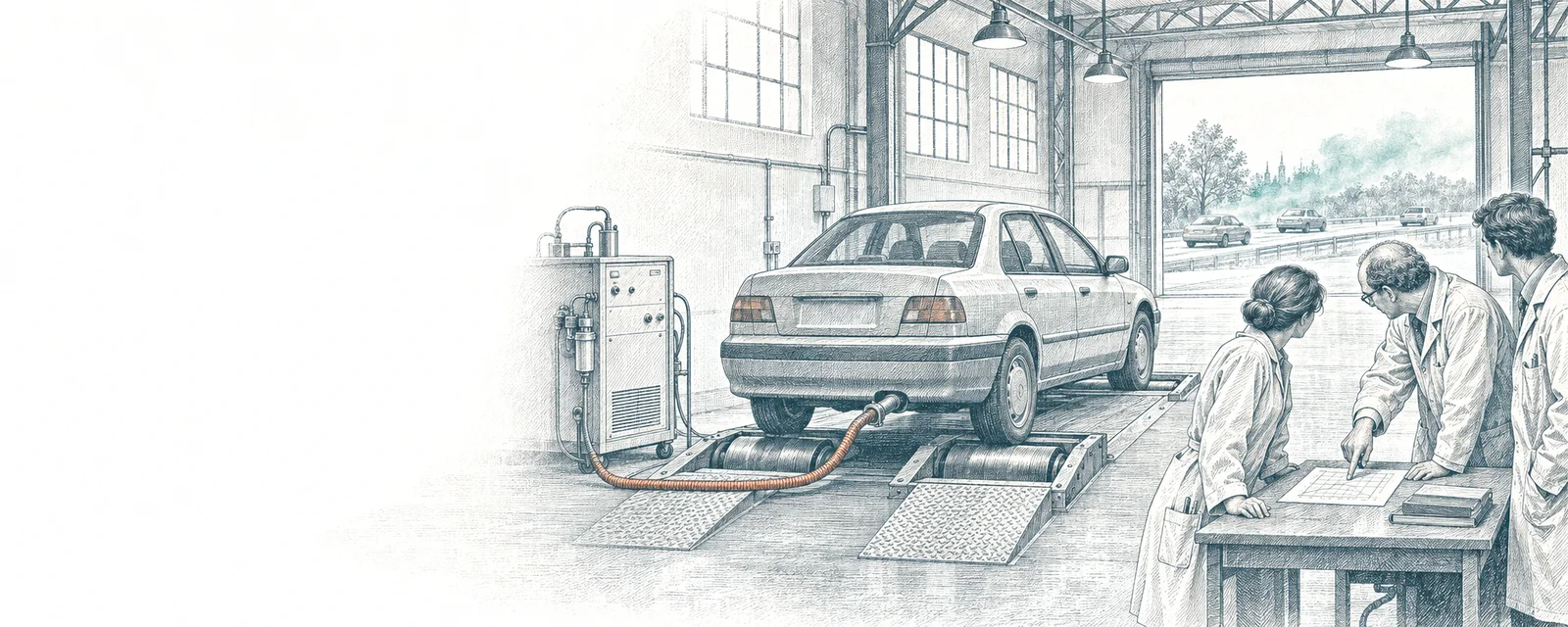
In November 2006 Volkswagen decided to fit the diesel engine for the US with software that runs clean only on the test bench. Engineers had objected. At the same time Volkswagen advertised the cleanest diesel and called ecological responsibility a corporate goal. The map shows what the decision looks like when these values carry weight in it.
A strict limit and an engine that did not meet it
In 2005 Volkswagen decided to sell diesel in the US on a large scale and developed a new engine for it [2]. According to the findings of the US Department of Justice, selling diesel cars in the US was an important strategic goal of the group [1].
From model year 2007, stricter limits for nitrogen oxides applied in the US [1]. The limit was 31 milligrams per kilometer, about one sixth of what the European standard of the time allowed [2]. In 2006 the responsible heads of engine development concluded that no engine could be built that met this limit and sold well at the same time [1].
To the outside, Volkswagen said something else. The annual report for 2006 states that the “Clean TDI” is an especially clean diesel that meets the toughest emissions standards, even in the US [3].
November 2006: the objections were on the table
The engineers built software that recognizes whether the car is on a test bench. There the exhaust treatment works fully. On the road it is turned down, and nitrogen oxides rise to as much as 35 times the limit [1]. In May 2006 an engineer warned in an email that the function served only to pass the test cycle and must not be used like this for the US project [1].
In the fall of 2006 engineers raised objections to the software and, with the support of their supervisors, took them to the head of engine development for the brand. At a meeting in November 2006 he decided to continue the project with the software. According to the findings of the Department of Justice he instructed those present, in sum and substance, not to get caught [1]. Volkswagen states that the decision was taken in late 2006 below the level of the Board of Management [7].
The decision was confirmed several times afterwards. In October 2007 the new head of engine development authorized the project although he knew that the cars would pass the test only with the software [1]. From model year 2009 they went on sale in the US [1]. In 2012 and 2013 the software was extended, and two supervisors had a document destroyed that explained how it worked [1].
Many knew, and no procedure gave the values any weight
The decision did not depend on one person. Engineers built the software, several supervisors approved it, their successors confirmed it. Those who objected were overruled and went on working. The software was disclosed to the authorities in August 2015 by an employee who told the truth against the instructions of his supervisors [1].
Volkswagen itself describes the trigger as a conflict of objectives: the limit could not be met within the time frame and budget of the project [2]. Under such pressure everyone decides for the goal they are measured by. The date and the budget have someone responsible for them. Honesty toward customers and authorities has nobody in the meeting.
The values existed. From 2008 Volkswagen named as its goal to lead ecologically as well [4][5]. The Code of Conduct of 2010 names responsibility and sustainability as group values and commits all employees to truthfulness toward authorities and the public [6]. During this time the software kept running and was extended.
A value that exists only in the mission statement has to be defended in every meeting by someone who risks something for it. It can be passed over because nobody raises it, or talked down by setting it against the deadline. That does not require bad intent on the part of everyone involved. It is enough that enough people look away.
The decision as a map
The map shows the decision of November 2006. In one future the engine goes into production with the software. In the other it comes without it: with exhaust treatment that meets the limit on the road as well, later or for the time being not in the US at all.
The first state shows what entered the decision. The deception and the nitrogen oxides were known; they were the substance of the objections. They carried no weight. The second state gives both rows the weight that Volkswagen's own statements assign to them.
F1: the engine goes into production with the software and passes the emissions test that way. F0: the engine comes without the software: with effective exhaust treatment, later or for now not in the US.
What counted in 2006
Schedule and budget on one side. On the other only the risk of being discovered, and that was considered manageable.
Size market launch for model year 2009, the core of the diesel campaign in the US
How it is scored
- V 6
- A new market for diesel was a declared strategic goal. That carries weight, but less than honesty toward customers and authorities and less than the existence of the company.
- I 3
- The new engine goes into production without delay, and the US campaign starts as planned. What is at stake is the entry into a market that Volkswagen wants to win for diesel.
- P 9
- Certain: with the software the engine passes the test, and the date holds.
Size budget of the engine project; no figure per car is documented
How it is scored
- V 5
- Project costs are real money, but the smallest good on this map.
- I 2
- The project stays within budget. A more elaborate exhaust treatment would have made the engine more expensive and cost development time. How much cannot be quantified from the sources.
- P 8
- Well supported: Volkswagen itself later names time frame and budget as the reason.
Size every car with this engine, every approval, every advertising claim about clean diesel
How it is scored
- V 9
- Volkswagen advertised that the engine met the toughest emissions standards. The group's Code of Conduct later commits all employees to truthfulness toward authorities and the public. Measured by the company's own statements, this is among the highest weights.
- I 6
- Every car sold carries an approval based on false information. Every buyer pays for a property the car does not have on the road. That affects the whole model line over its entire life.
- P 0
- This is how the decision was made in 2006: the objection was on the table and changed nothing. The row dropped out of the calculation as if it did not exist.
Size nitrogen oxides from hundreds of thousands of cars, year after year
How it is scored
- V 8
- Health and the environment. Volkswagen called ecological responsibility a corporate goal and wanted to lead ecologically as well by 2018.
- I 4
- In everyday driving the cars emit a multiple of what the limit allows. Nitrogen oxides harm the airways. The quantity grows with every car sold and every kilometer driven.
- P 0
- This is how the decision was made in 2006: the objection was on the table and changed nothing. The row dropped out of the calculation as if it did not exist.
Size criminal proceedings in the US, recall or buyback of the cars, the company's reputation
How it is scored
- V 9
- What is at stake is trust in the brand and, in the end, the existence of the business.
- I 10
- In the US, violations of the Clean Air Act carry penalties. Added to that are the recall of all cars and the loss of credibility with customers and authorities. That is the largest difference on the table, which is why it stands at 10.
- P 1
- This is how 2006 did the sums: the instruction was, in substance, not to get caught. Discovery was considered avoidable.
With the company's own values
The same five rows. Deception and nitrogen oxides carry the weight that Volkswagen's advertising and mission statement give them.
Size market launch for model year 2009, the core of the diesel campaign in the US
How it is scored
- V 6
- A new market for diesel was a declared strategic goal. That carries weight, but less than honesty toward customers and authorities and less than the existence of the company.
- I 3
- The new engine goes into production without delay, and the US campaign starts as planned. What is at stake is the entry into a market that Volkswagen wants to win for diesel.
- P 9
- Certain: with the software the engine passes the test, and the date holds.
Size budget of the engine project; no figure per car is documented
How it is scored
- V 5
- Project costs are real money, but the smallest good on this map.
- I 2
- The project stays within budget. A more elaborate exhaust treatment would have made the engine more expensive and cost development time. How much cannot be quantified from the sources.
- P 8
- Well supported: Volkswagen itself later names time frame and budget as the reason.
Size every car with this engine, every approval, every advertising claim about clean diesel
How it is scored
- V 9
- Volkswagen advertised that the engine met the toughest emissions standards. The group's Code of Conduct later commits all employees to truthfulness toward authorities and the public. Measured by the company's own statements, this is among the highest weights.
- I 6
- Every car sold carries an approval based on false information. Every buyer pays for a property the car does not have on the road. That affects the whole model line over its entire life.
- P 9.5
- As good as certain: the software is the deception. It has no purpose other than to show different values on the test bench than on the road.
Size nitrogen oxides from hundreds of thousands of cars, year after year
How it is scored
- V 8
- Health and the environment. Volkswagen called ecological responsibility a corporate goal and wanted to lead ecologically as well by 2018.
- I 4
- In everyday driving the cars emit a multiple of what the limit allows. Nitrogen oxides harm the airways. The quantity grows with every car sold and every kilometer driven.
- P 9
- Well supported, by the decision itself: the software is built because the engine does not meet the limit in normal driving.
Size criminal proceedings in the US, recall or buyback of the cars, the company's reputation
How it is scored
- V 9
- What is at stake is trust in the brand and, in the end, the existence of the business.
- I 10
- In the US, violations of the Clean Air Act carry penalties. Added to that are the recall of all cars and the loss of credibility with customers and authorities. That is the largest difference on the table, which is why it stands at 10.
- P 2
- Hard to quantify. The software is built to stay undiscovered, and at the time authorities tested on the bench. Over the life of a model line discovery still remains possible: through measurements on the road or through someone who talks.
Decision map: two states of the same decision. In the second state the two value rows carry weight, and discovery is no longer ruled out.
How to read the map
Each row names exactly one impact: one difference between the two futures. V is the weight of the good at stake (0 to 10), I is the size of the difference (10 is the largest on the table, all others are in proportion to it), P is the plausibility given the evidence on the day of the decision (0 to 10). The numbers are assumptions of this reconstruction, not measurements. Each one carries its reason so that it can be challenged.
The scoring uses what was known on the day of the decision. What became known later is in the last section and enters no number on the map.
Nine years in which the decision was confirmed again and again
- May 2006
An engineer warns by email that the function serves only to pass the test cycle and must not be used like this for the US project.
Objection - Fall 2006
Engineers raise objections and take them to the head of engine development.
Objection - November 2006
The head of engine development decides to continue with the software.
Decision - October 2007
His successor authorizes the project, knowing that the cars pass the test only with the software.
confirmed - From model year 2009
The cars go on sale in the US, advertised as clean diesel.
confirmed - 2012 to 2013
The software is extended. Two supervisors have a document destroyed that explains how it works.
confirmed - March 2014
A research group measures up to 40 times the limit on the road. Afterwards supervisors decide to conceal the software from the authorities.
confirmed - August 2015
An employee tells the authorities the truth against the instructions of his supervisors.
Disclosure - 18 September 2015
The US Environmental Protection Agency makes the violation public.
Notice
Fig. 1: Over nine years the decision was confirmed by changing people. Sources: US Department of Justice, Statement of Facts (2017); EPA, notice of 18 September 2015.
The figure shows the sequence from the decision to the disclosure. At five points at least, the same question was on the table again: at the authorization in 2007, at the market launch, when the software was extended, after the road measurements of 2014 and when the authorities asked questions.
Each time different people decided, and each time the decision came out the same. In 2014 a research group measured up to 40 times the limit on the road [1]. After that several supervisors decided to conceal the software from the authorities while appearing to cooperate [1].
During the same period Volkswagen reaffirmed its goals to the outside. The annual report for 2014 names as its vision to be the leading automotive group in ecological terms by 2018 [14].
What would have changed the decision
Volkswagen apparently lacked a procedure that gives its stated values a weight in every decision, even under pressure of time and cost. Such a procedure changes three things.
First, the objection appears in the decision. On the map the deception is a row with value, size and plausibility. It stands next to the schedule and the budget and enters the same total. Nobody has to defend it against a superior in the meeting; it is already there.
Second, a value is harder to talk down. Anyone who gives the row a low weight has to write that down as a number with a reason. A weight of 2 for truthfulness toward authorities is a sentence someone has to sign and others read. In 2006 nobody had to: the row disappeared without anyone having scored it.
Third, the values stay the same whoever is at the table. Over nine years the decision was confirmed by changing people. If the company's values are fixed weights in every decision, their rank does not depend on how great the pressure happens to be and on who has the courage to object.
A map does not stop anyone who wants to deceive. But it changes what looking away costs. Whoever agrees is agreeing to a statement in which the deception is named and scored. That makes it traceable how the decision was made and who set which weight.
What happened afterwards
On 18 September 2015 the US Environmental Protection Agency made the violation public [8]. Four days later Volkswagen announced that about eleven million vehicles were affected worldwide [2]. In the US it was about 585,000 [1], in Germany 2.4 million [13].
In January 2017 Volkswagen pleaded guilty in the US to three felony counts and paid a criminal penalty of 2.8 billion dollars plus 1.5 billion dollars in civil proceedings [9]. For buybacks, compensation and environmental obligations the group had already committed up to 14.7 billion dollars in 2016 [10]. Volkswagen's annual reports show special charges of 32.2 billion euros in total for 2015 to 2020 [11]. In 2020 the German Federal Court of Justice ruled that Volkswagen is liable to buyers for intentional damage contrary to public policy [12].
The Supervisory Board wrote in the annual report for 2015 that the misconduct ran contrary to all of the values that Volkswagen stands for [2].
Values count only when they are part of the decision.
A mission statement on paper and decisions that contradict it: authorities have found this pattern in several major cases. Each time the values were set down, and each time they carried no weight in the decisions.
- 2002 to 2016
Wells Fargo
Over years, employees opened millions of accounts that customers had not authorized. According to the Securities and Exchange Commission this contradicted the needs-based selling model the bank described to its investors. The bank fired about 5,300 employees and in 2020 paid 3 billion dollars in total [15][16].
- 2016 to 2019
Boeing 737 MAX
Two of the manufacturer's pilots deceived the US aviation authority about the MCAS flight control system. After two crashes with 346 dead, Boeing paid over 2.5 billion dollars. The Department of Justice wrote that employees chose the path of profit over candor [17].
- 2001 to 2007
Siemens
According to the US Department of Justice, bribery was standard operating procedure across much of the group. The Securities and Exchange Commission found that the tone at the top was inconsistent with an effective compliance program. In 2008 Siemens paid more than 1.6 billion dollars in total [18][19].
Sources
- US Department of Justice (2017): Statement of Facts to the plea agreement of Volkswagen AG, Exhibit 2
- Volkswagen AG: Annual Report 2015
- Volkswagen AG: Annual Report 2006
- Volkswagen AG: Annual Report 2008
- Volkswagen AG: Annual Report 2009
- Code of Conduct of the Volkswagen Group, as of 05/2010, German edition (reproduced by Motor-Kritik)
- Volkswagen AG: Annual Report 2017
- US Environmental Protection Agency: Notice of Violation of 18 September 2015
- US Department of Justice (11 January 2017): Volkswagen agrees to plead guilty and pay 4.3 billion dollars
- US Department of Justice (28 June 2016): settlement of up to 14.7 billion dollars
- Volkswagen AG: Annual Reports 2016 to 2020, special items from the diesel issue
- German Federal Court of Justice: press release 63/2020 on the judgment of 25 May 2020 (VI ZR 252/19)
- German Bundestag: report of the 5th committee of inquiry, printed paper 18/12900
- Volkswagen AG: Annual Report 2014
- Consumer Financial Protection Bureau: consent order, Wells Fargo Bank, 2016-CFPB-0015 (8 September 2016)
- US Securities and Exchange Commission (21 February 2020): Wells Fargo to pay 500 million dollars
- US Department of Justice (7 January 2021): Boeing charged with 737 MAX fraud conspiracy, agrees to pay over 2.5 billion dollars
- US Department of Justice (15 December 2008): Siemens AG pleads guilty to Foreign Corrupt Practices Act violations
- US Securities and Exchange Commission (15 December 2008): SEC Charges Siemens AG for Engaging in Worldwide Bribery
 Decision under uncertainty
Challenger, 1986
A risk without a number is not a risk of zero.
The engineers could not quantify the risk. The map shows they did not have to: it was enough to know on which side of the tipping point it lay.
Read the case → Decisions over time
Kodak, 1981 to 2003
A good decision has an expiry date.
With what was known in 1981, staying with film was right. The reasoning had an expiry date. When it was reached, the decision stayed in force.
Read the case → Transparency of a decision
Netflix and Qwikster, 2011
What is not open inside cannot be explained outside.
The customers were not told why. Inside the company nobody voiced the doubts. A decision that is not transparent inside cannot be explained outside.
Read the case → The method behind the mapsThe full derivation of V × I × P is on the page Reason Based Decision Making for Business.
To the derivation →